Prior to the conquest and colonisation of North America, the areas now known as Canada, northern Mexico and the United States were home to a large number of indigenous cultures, each with its own language. Many of those languages were not closely related, and while many people spoke several of them, it was often necessary to communicate with individuals from very different linguistic backgrounds.
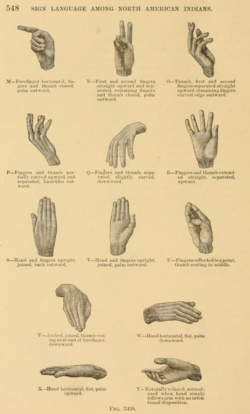
To solve this language dilemma, these indigenous nations developed a form of signing, known as ‘Plains Indian Sign Language’, ‘Hand Talk’, and by several other names. Historically, it was used for international commerce and diplomatic relations, much as Latin was once used in Europe. It combined simple gestures – such as pointing upwards for ‘up’ – with complex hand-movements denoting abstract concepts. It also existed in a written form comprising petroglyphs, pictographs and hieroglyphs that marked territory and provided information about local water sources and other crucial information.
Today, Plains Indian Sign Language is – like many North American languages – endangered, but a recent resurgence in interest signals that it may still have a future.
Photo Source: https://en.wikipedia.org/wiki/Plains_Indian_Sign_Language