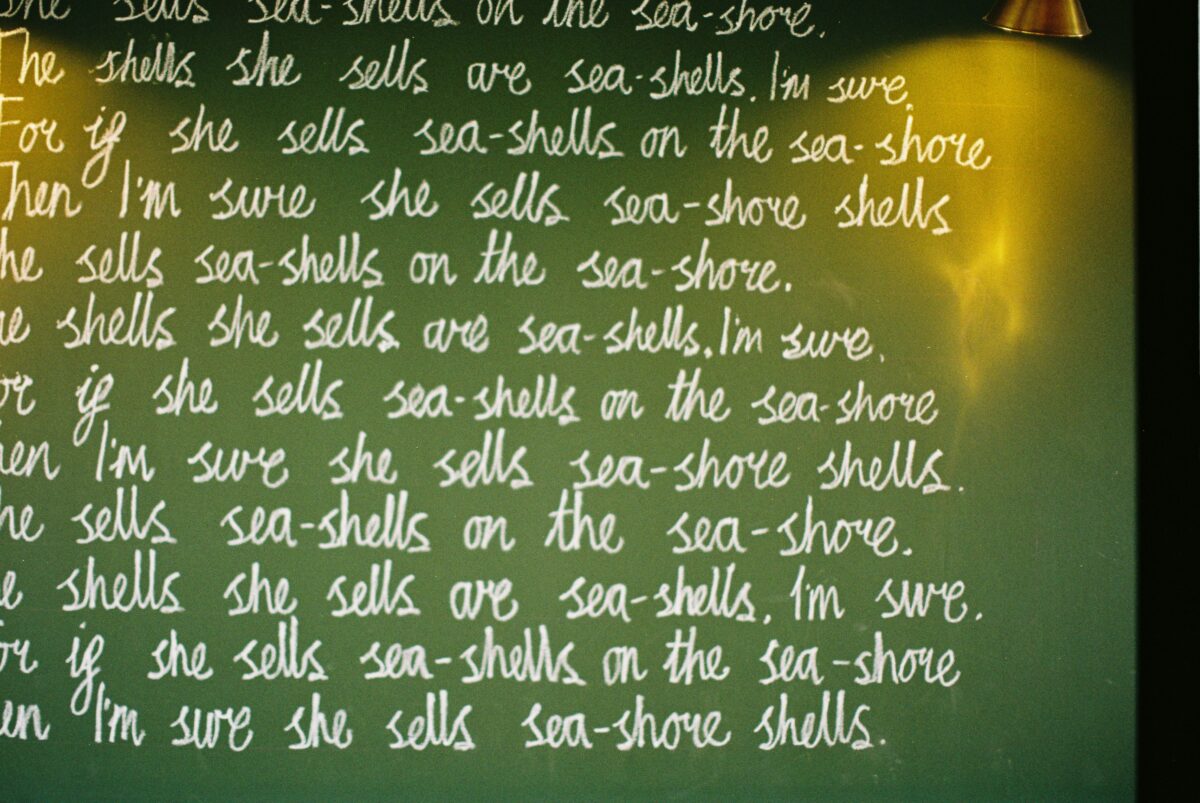
She sells seashells on the seashore.
Tongue twisters – in any language – are a lot of fun, and they also provide us with opportunities to work on our diction and fluency. Often, they rely on the speaker alternating rapidly between phonemes that are similar, but different. Frequently they also use a mixture of alliteration and rhyme.
Tongue twisters became extremely popular staples of English-language humour in the nineteenth century, and they exist in other languages too. In Spanish, a tongue twister is a trabalenguas (tongue jammer), for example; and the sign language version of a tongue twister is known as a “finger fumbler”.
Experiments conducted in-house at 101translations seem to suggest that tongue twisters are often easier to enunciate in one’s second language. Contact us for details!
Photo Source: https://unsplash.com/photos/she-sells-sea-shells-on-the-sea-shore-text-schbWii1C4U