101translations

Categories
Interesting facts

Stone Age Language

We know that humans started using language more or less as we do about 100,000 years ago, but what did they sound like? And what about the precursors of modern humans, who must have incrementally moved closer to using language much as we do today? What sort of noises did they make?

It may be impossible to reconstruct a whole language or communication system with the few artefacts we have from the extremely remote past, but the fossilised bones of our ancestors provide some clues about what they sounded like. They can tell us about the position of the vocal tract, the structure of the brain and the size of the spinal cord and how these gradually evolved over time to what we see today. If, as researchers believe, the gradual development of language provided our ancestors with an evolutionary advantage, this will have impacted on how the human body developed over time.

About 27 million years ago, an ancestor we have in common with various monkey species was the first to be able to make some vowel sounds, a necessary precursor to language. 3.2 million years ago, Australopithecus Afarensis could make some vowel sounds, but not ‘i’, and probably communicated with a limited number of distinctive sounds. 1.6 million years ago, Homo Erectus walked much as we do, might have cooked food, and was able to use a wider range of sounds, perhaps employing onomatopoeia to create simple words. 50,000 years ago, when Neanderthal people had spread across Europe, they had the cognitive capacity for language, but probably sounded quite different to us, with more nasal sounds, like in modern-day French. Their complex behaviours suggest that they had language, as we do, and used it to organise activities such as hunting, discussing abstract concepts, and teaching skills to each other.

40,000 years ago – very little time, really, when you think about it – Cro-Magnons, early modern humans, were not speaking the same languages as we do now, but they were speaking in the same way. Their vocal tracts, brain structure, and the size of their spinal cords were the same as they are now.

Check out The Language Puzzle – a fascinating book by archaeologist Steven Mithen – if you’d like to know more!

Photo Source: https://unsplash.com/photos/a-stonehenge-in-a-field-with-the-sun-setting-behind-it-GyH_N1UPXco

Categories
Interesting facts

Socotri

Socotri is the native language of Socotra, an archipelago that’s part of Yemen. Most of the approximately 50,000 inhabitants are Socotri people from the Al Mahrah tribe. Their language is one of the oldest in southern Arabia.

Socotri is a semitic language related to other languages spoken on the Arabian mainland, including Mehri. It is used not just for everyday communication, but also for the rich tradition of poetry on the island.

Of course, as is the case with so many minority languages, today Socotri is under threat. Recognising its importance, in 2026, the Socotri Language Center for Studies and Research, supported by UNESCO, held a special day dedicated to the language and its cultural and intellectual importance.

One of the most hopeful signs for the future? A new digital platform with keyboard layouts for laptops and mobile phones, making it easier to integrate the use of Socotri into an increasingly globalised world, and into formal educational curriculums.

And in case you were wondering – yes, 101translations can also translate into Socotri.

Photo Source: https://unsplash.com/photos/a-tree-with-a-mountain-in-the-background-REwZEYzw19g

Categories
Interesting facts

Dental Plaque and Written Language

What can we learn from ancient dental plaque?

A lot more than you might think!

Researcher Anita Radini was examining 1000-year-old dental tartar from a woman’s bones in Germany when suddenly she noticed that it contained some bright blue pigment. Wanting to know more, she had it analysed and found out that it was ultramarine.

Ultramarine is a pigment that, 1000 years ago, was sourced only from lapis lazuli originating in a single region of Afghanistan. This extremely valuable substance was worth as much as gold and was used in mediaeval painting to render the robes of the Virgin Mary in the intricate manuscripts being produced by the leading artists and calligraphers of the day.

The presence of this pigment in the woman’s dental tartar suggested that she had probably been one of those artists, using her tongue – as artists do – to bring the bristles of her paintbrush to a neat point. But some art historians doubted that a woman would have been skilled enough to work with such a valuable substance and proposed that she must have been the real artist’s cleaning lady.

Ultimately, Radini and her colleagues were able to prove that some women in religious orders at the time were indeed creating art of this calibre, and even located a number of manuscripts signed by their female creators. The evidence is clear that female scribes, as well as male ones, were indeed making books with lapis lazuli pigment in the same area and around the same time this woman was alive.

This amazing breakthrough opens up many research avenues into the work of women artists and calligraphers and the manuscripts they created to communicate the Christian message of mediaeval Europe – and into the rich, surprising potential of dental tartar as a vehicle for clues to the past.

Think of that next time you lick your pencil.

Photo Source: https://unsplash.com/photos/long-black-haired-woman-smiling-close-up-photography-1AhGNGKuhR0

Categories
Interesting facts

Mothers and Children Sync Brain Activity in Non-Native Languages

In general, humans tend to show neural synchrony when they talk, play or sing together. And it has long been recognised that when mothers and their small children play together, their neural activity becomes synchronised.

New research shows that this process takes place between mothers and children even when they are not interacting in their native language, showing that this brain-bonding process is effectively translated along with their thoughts.

By studying mothers and their children at play, first in their native language, and then in another language, and measuring their neural activity, the researchers showed that brain synchrony occurred in either language, as compared to when mothers and children played separately.

The implications of this research are considerable. Parents in bilingual relationships, for example, often acquire their second language later in life, and worry that they will not be able to interact with their children on as emotional a level as the parent using their mother tongue. In fact, the children will experience brain synchrony regardless of the language or languages their parents use with them, and whether or not they are fluent in those languages.

And, of course, motherly love is the ultimate universal language!

Photo Source: https://unsplash.com/photos/selective-focus-photo-of-woman-lifting-child-during-daytime-Wr3HGvx_RSM

Categories
Interesting facts

When did humans start using language?

We’ve already written about various different forms of animal communication – and we know that, while animals often communicate in relatively complex ways, they don’t use language as we do.

But when did people actually start to use language?

Shigeru Miyagawa, a linguist at the Massachusetts Institute of Technology, alongside Rob DeSalle and Ian Tattersall from the American Museum of Natural History have carried out genetic analyses that suggest that our ancestors became cognitively capable of language about 135,000 years ago.

Around that time, the human population started to split, with small groups of people heading off in different directions. Before that happened, there was one small, undivided population of humans. Gradually, as they diverged, the original language they spoke did too, until eventually thousands of languages were being spoken all over the world.

Around 100,000 years ago, we see people starting to express themselves with the drawings and symbols that are a precursor to writing, suggesting further development in language, and also that language enabled the emergence of modern human behaviour by allowing people to discuss things in abstract and conceptual ways using vocabulary and syntax, and to learn about things such as emerging technologies and complex social behaviours from one another.

Today we’re in another period of extremely rapid language development, with images like emojis increasingly communicating complex thoughts and reactions. How will this impact on our behaviour, and on human cultural development, in the future?

Photo Source: https://unsplash.com/photos/diverse-team-collaborating-around-a-table-with-charts-vasBHKO3GSs

Categories
Interesting facts

Language and Psychiatry

When patients present with conditions like psychosis, their caregivers use language to study their cognitive function and, hopefully, reach a diagnosis that will pave the way to an effective treatment plan.

So far, however, psychiatrists only examine their patients in one language, despite the fact that about half of the people in the world are actually bilingual.

We know that resources are often very tight in medicine, but ideally bilingual patients presenting with psychiatric illness would be assessed in both of the languages they speak, to see if there are any differences between how their illness manifests, depending on the language they are speaking, and whether any future treatment plan can take their bilingualism into consideration.

Also, purely from a research point of view, given that we know that bilingualism offers some protection against age-related cognitive decline, it would be fascinating to explore whether or not – and how – it interacts with the wide variety of psychiatric illnesses people can suffer from.

Photo Source: https://unsplash.com/photos/a-man-sitting-on-a-couch-next-to-a-woman-rCrqVVoLSow

Categories
Interesting facts

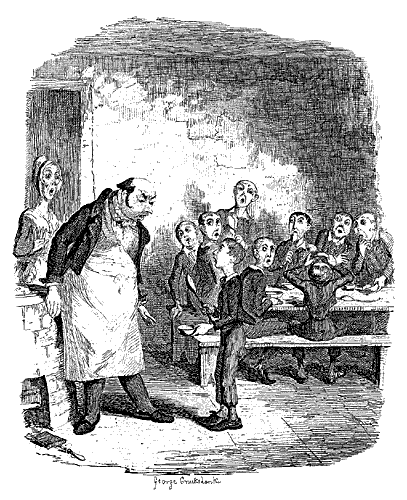
What do Oliver Twist and Sheldon Cooper Have in Common?

Oliver Twist and Sheldon Cooper – two endearing, fictional little boys from very different backgrounds. Oliver, of course, is the brainchild of the great English writer Charles Dickens, and Sheldon, in Young Sheldon, provides the backstory to Sheldon Cooper from popular TV sitcom, The Big Bang Theory. 

From a linguistic point of view, the two characters have one very interesting thing in common. Somehow, neither of them sounds even slightly like the people they’ve grown up with and around. 

The musical Oliver was released in 1968, featuring an adorable little ragamuffin who has had a very difficult start in life. After spending his early childhood in a dreadful orphanage, he is sold into service to an undertaker, and then runs away to join a gang of juvenile pickpockets in London. Tough. And yet, while everyone around Oliver speaks in thick working-class accents, somehow, he speaks in Oxford English with the crisp diction generally used to denote the aristocracy. 

Little Sheldon comes from a much happier background. His blue-collar family loves him, treats him well, and tolerates his extremely irritating idiosyncrasies. Everyone around him, from his family to his preacher, speaks in a broad Texan accent but somehow Sheldon speaks standard American English. 

OK, so maybe Sheldon could have picked his accent up from TV or the radio, or maybe deliberately adopted it, but Oliver certainly couldn’t have. So, what’s going on?

People often associate particular accents with certain social classes and aspirations. The directors of both of the productions under discussion here are cleverly using accent discrimination to make their point. Oliver already sounds like an aristocrat because, although he doesn’t know it, he is one. When his true origins are revealed at the end of the story, he can slide right into his new family already sounding like one of them. And Sheldon can be made to sound ‘cleverer’ because, in the United States, a broad Texan accent is not coded as ‘intellectual’.

We all adjust our accents, unconsciously and sometimes consciously, depending on who we are with and what we are doing. And, whether or not we mean to, in the process we help to reinforce the accent discrimination that is part of almost every language group in the world.

Photo Source: George Cruikshank, Public domain, via Wikimedia Commons

https://upload.wikimedia.org/wikipedia/commons/c/cd/George_Cruikshank_Oliver_Twist.gif

Categories
Interesting facts

The Sound of Ancient Languages

When the languages of preliterate peoples die, they disappear forever, leaving at best a trace of themselves in placenames that stay the same even after the dominant language changes.

But what about languages that have a written form, but that are no longer spoken?

Experts may still be able to read these languages, but often they don’t know how they were pronounced, and can only guess.

The Voices of Dead Languages Project at Charles University in Prague is reconstructing what a number of ancient languages, including Akkadian, Babylonian and Hittite, sounded like. They are using AI, alongside traditional linguistic knowledge, to figure out similarities between these dead languages and other living languages that are related to them. By comparing different languages that are all related to the dead language, and finding out what pronunciations they have in common, they can start to see patterns that provide insights into the likely pronunciations of the past.

Of course, the research also poses some interesting linguistic-philosophical questions. Like: can a language truly be ‘dead’ when it lives on in other languages – as, for example, much of Latin persists in the Romance languages? When is a language ‘dying’ and when simply going through a normal process of evolutionary change? Is the difference always clearcut or are there many shades of grey?

Food for thought.

Photo Source: https://unsplash.com/photos/photo-of-open-book-yri82tuk2TQ